Cover image for Othismos Returns to No Name Games!

Just a quick little newspost for y’all! As part of my ongoing efforts to sunset my itch.io account, I’ve finally moved Othismos, my business card mass battle wargame, over to the main No Name Games site.

So what is OTHISMOS?

For those of you whom this is your first experience with OTHISMOS, it’s a D6-driven mass battle system designed for anything from 10mm to 28mm scale. I wanted something that was simple to pick up and remember, with a minimum of rules to learn, and I think I succeeded: the entire system fits on both sides of a standard business card - perfect for when you just want to play a game but don’t want to bust out a 300-page rulebook.
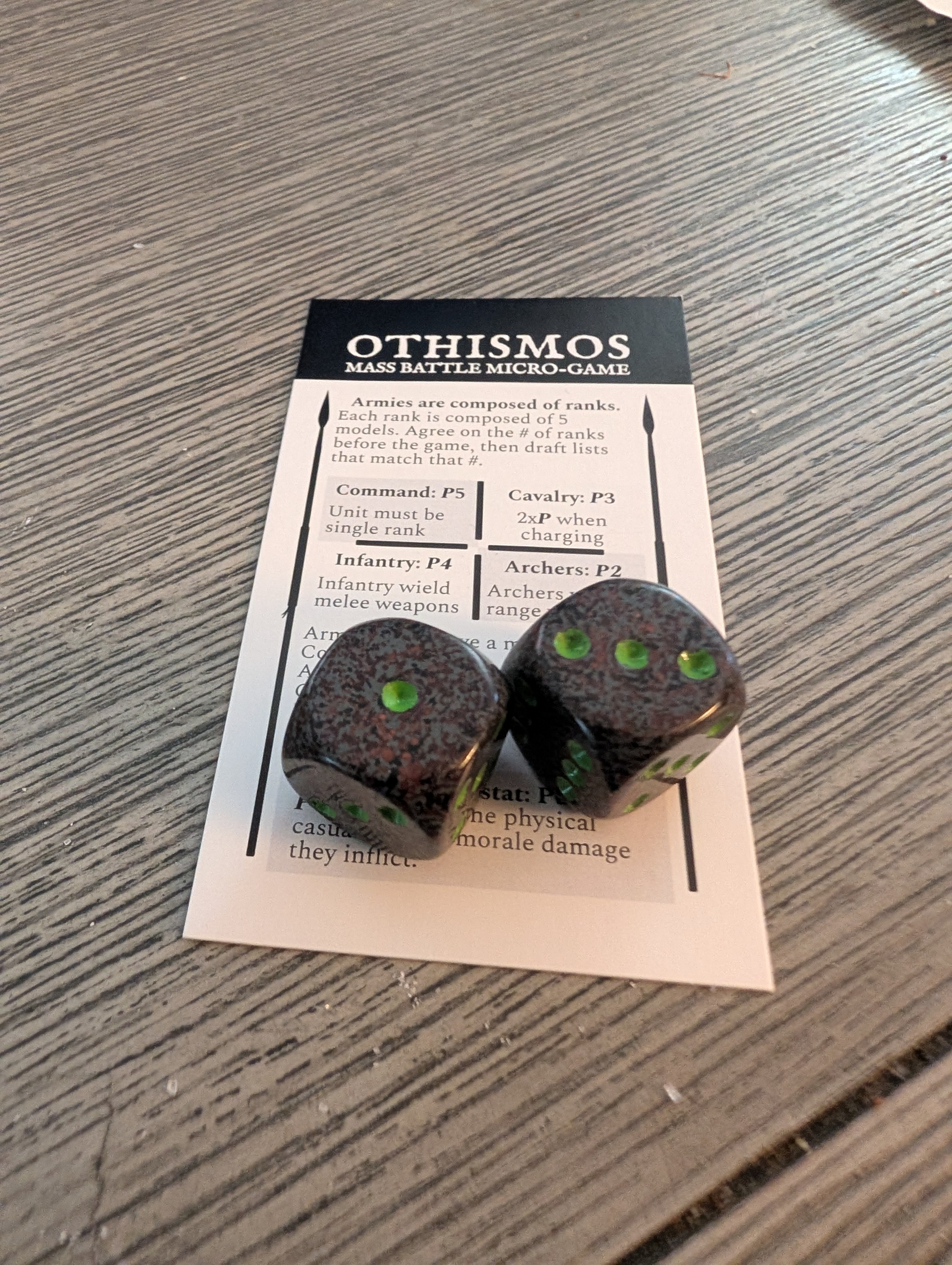
Othismos rules next to pair of dice.

Othismos is generally setting and time-period agnostic. It will work just as well for Orcs vs Dwarves as it will for Spartans vs Persians: the system is designed to work with anything before the advent of gunpowder, and the rules are simple enough that you can house-rule overtop of them to your heart’s content.

As long as all of your units have clear facings and flanks, you’re good to go.

How does the system work?

For each unit in the army, roll a D6 and add up the dice. This is your initiative score. Highest score goes first. Players then alternate activating units by spending a number of points equal to the number of ranks in the unit to activate it. So, e.g. a Command unit would spend one point to activate.

When it comes to melee combat, the attacker rolls a D6 and adds its P value - Push, which is a combination of the physical casualties and morale shock that one unit inflicts on another. Depending on which face of the unit is defending, the defender rolls D6 + their P + 2 (front), D6 + 1 (sides) or just a straight D6. If the attacker wins combat, they deal a number of casualties equal to their P value: 5 for Command, 4 for Infantry, 3 for Cavalry and 2 for Archers.

Ranged combat is simpler - both attacker and defender roll D6 + their respective P and compare values. If the attacker wins the roll, they deal P casualties.

OTHISMOS is my love letter to ancient and medieval warfare, stripped down to its simplest parts and shoved onto a business card. It’ll be free to download forever (along with a free scenario that puts you in Leonidas’ sandals and lets you refight Thermopylae) and if you pick up any of my other physical rulebooks or scenarios, I’ll add a copy of OTHISMOS to your order for free.

Otherwise, you can find it here.

OTHISMOS is just one part of what I’m moving over to the main site. I’ve got plenty more planned, including more ‘Eleven Bravo’ content and new scenarios. Thanks for following along with the move — your support makes No Name Games possible.
Tags: 28mm,Ancients
Cover image for An Introduction To The Trials Of Herakles

Have you ever wanted to kick Herakles’ ass? NOW YOU CAN.

Welcome to the “The Trials of Herakles”.

So what is “The Trials Of Herakles”?

Put simply, “The Trials Of Herakles” is a twelve-scenario mission pack that reimagines each of Herakles’ twelve labors through the lens of encounters in DEMIGOD. You can slay the Nemean Lion, try your best to clean out King Augeus’s stables, pit your wits against Hippolyte of the Amazons and more. The book is designed with solo play in mind (as is the DEMIGOD core rulebook), but I am playtesting a set of profiles to allow a second player step into the sandals of Herakles himself and really see if they can get the labors done before your adventuring party does.

What else is in the book?

Besides the twelve labors, you’ll have three different boons from Hera, allowing her to be your demigod’s patron if you so choose. You’ll also have access to the bestiary at the back of the book, meaning you can add the monsters you encounter in “Trials of Herakles” to your monster hunts in normal games of DEMIGOD.

What do I need to play?

Besides a copy of the “Trials of Herakles” beta rules (available here), you’ll also need a copy of the DEMIGOD core rulebook (available here from my own site, or here as a PDF from Wargame Vault), as well as some miniatures to represent both your own adventuring party and the monsters you’ll encounter throughout “The Trials of Herakles”. For a general primer on what miniatures match the “vibe” of DEMIGOD, check out this post I made a couple weeks ago on the subject.

If you’re looking for miniatures specific to “Trials Of Herakles”, so far I recommend this lion by Epic Miniatures. I’ll keep this post updated as I work through the other 11 scenarios, so if you’re looking for inspiration for tackling the quests from “Trials of Herakles”, don’t forget to check back!

Tags: DEMIGOD,28mm,Ancients
Cover image for Designing A Modern Combat Skirmish Wargame

So I wanted to apologize for the second hiatus. To be honest, I didn’t feel like writing blog posts. Or games, if I’m honest. You know that saying of “Find a job you love and you’ll never work a day in your life”? Well, writing games was starting to feel a lot like work.

Now that I’ve taken a bit of a break, I’m back in business. Expect new blog posts, plus new game content. I’m about 40% done with “The Trials Of Herakles”, and I’m hoping to get that out to playtesters by the end of this year (2024). I’ve also had a new game in the works. Well, for a given sense of “new” - it’s a rewrite of a game I finished years ago and never released. That game was called “Humanity In Flames”. It started life as a what-if scenario: I’d just finished Dan Abnett’s “Embedded” and the way he’d written combat really stuck with me. I wanted to write a game that evoked the combat in that book - something frenetic and fast-paced.

Cover of Embedded by Dan Abnett

What I ended up coming up with could best be described as “Force On Force without all the charts.” It combined basic versions of the unit profiles from Warhammer 40,000 4th edition with Force on Force’s troop quality dice, and played much more like Warhammer 40,000 than it did Force on Force. Throw in Chain of Command’s army list system, and you have the first version of Humanity In Flames. I eventually re-scaled the game into a 15mm company-level wargame, but that still didn’t get me exactly where I wanted.

Enter Covering Fire

From there, I went back to the drawing board. I re-examined what I wanted out of my game: fast-paced, frenetic combat that didn’t worry about bean-counting. So I started poking around. I already knew Chain of Command, but I wasn’t a huge fan of its Chain of Command points. Eventually, I stumbled upon Covering Fire, a little two-page ruleset from the folks behind One Page Rules (OPR). While it doesn’t appear to still be available on their website, Covering Fire was OPR’s take-off of Crossfire, a company-level WWII wargame written by Artie Conliffe in 1996. Covering Fire (and Crossfire before it) is designed to be a fast-paced game, for all that it’s company-level. There are no turns. There is no measuring. Units move from terrain feature to terrain feature. Units accrue “pin markers” that are a representation of how combat effective they are - the more pin markers a unit has, the less effective they are, until they’re killed.

Making It My Own

I kept most of these features, excepting that units have to move from terrain feature to terrain feature - this makes for terrain-heavy boards, and not everyone has enough terrain to saturate a 6’x4’ board. I added vehicle rules that are vaguely similar to Chain of Command’s, but vastly simplified. I still have to flesh out those vehicle rules I mentioned above, plus make some changes to how infantry work (namely as individual models vs stands). I hope to document those rules for y’all in some upcoming blog posts, so stay tuned!

In the meanwhile, you can read those rules (tentatively titled “Eleven Bravo”) here.

Tags: 15mm,Modern,Eleven Bravo
Cover image for Exciting New Developments

So The Blog With No Name (and No Name Games as a whole) have been on a bit of a hiatus for a couple reasons. First was that I started a Kickstarter for DEMIGOD, No Name Games’s first solo-published game. When it looked like that Kickstarter wasn’t going to fund, I turned to setting up other ways for getting the game funded and “paying myself back”. So far, I’ve arrived at three solutions:

  1. Slowfunding via Itch.
  2. Slowfunding via Cardboard Monster.
  3. Some combination of the above.

As it stands, I’m looking mostly at #3. Itch would handle the distribution of PDF/digital versions of my games and their associated 3D printing files, while Cardboard Monster would handle physical distribution. So here’s how things will break down:

  • If you want a PDF copy of DEMIGOD and/or the 3D print files, those will be available from Itch for $15 (PDF) or $10 apiece for the 3D printing files.
  • If you want a print copy, you’ll have two options: order straight from me for $30; or order from Cardboard Monster for $30.

Speaking of physical copies, that leads to my second point: as of the end of next month, I’ll have physical copies of DEMIGOD in Nowhere’s Store of Forgotten Lore in Springfield, MO. So if you’re in the Springfield area, definitely check it out!

Nowhere's Store of Forgotten Lore storefront

The third thing doesn’t really have to do with the first two, but I also redesigned the No Name Games website! I got rid of the big central logo in place of something a little more understated. The click effect is also gone on the logo. Makes the site a little longer, but now everything should load faster - especially because the site and blog are now rolled into one.

I’ll be back next week with our regularly scheduled programming - a post on how to price your TTRPGs.

Tags: DEMIGOD